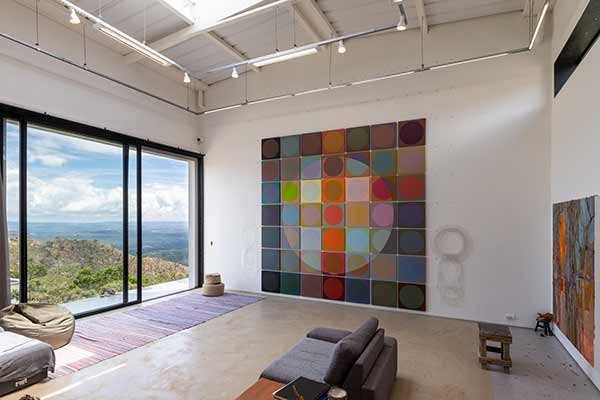
Surrounded by waterfalls, canyons, rock formations, and endemic species of the Cerrado biome, Gisele Camargo was invited by the landscape to reflect on the fundamentals of painting. The Rio de Janeiro-born artist, born in 1970, moved to Serra do Cipó, near Belo Horizonte, and established a studio there that also functions as an artist's residence and space for interdisciplinary research. The work that emerged from this immersion is on display at the Mitre Gallery in São Paulo, in the solo exhibition "candeia," with curatorial text by Miguel A. López, until October 3rd.
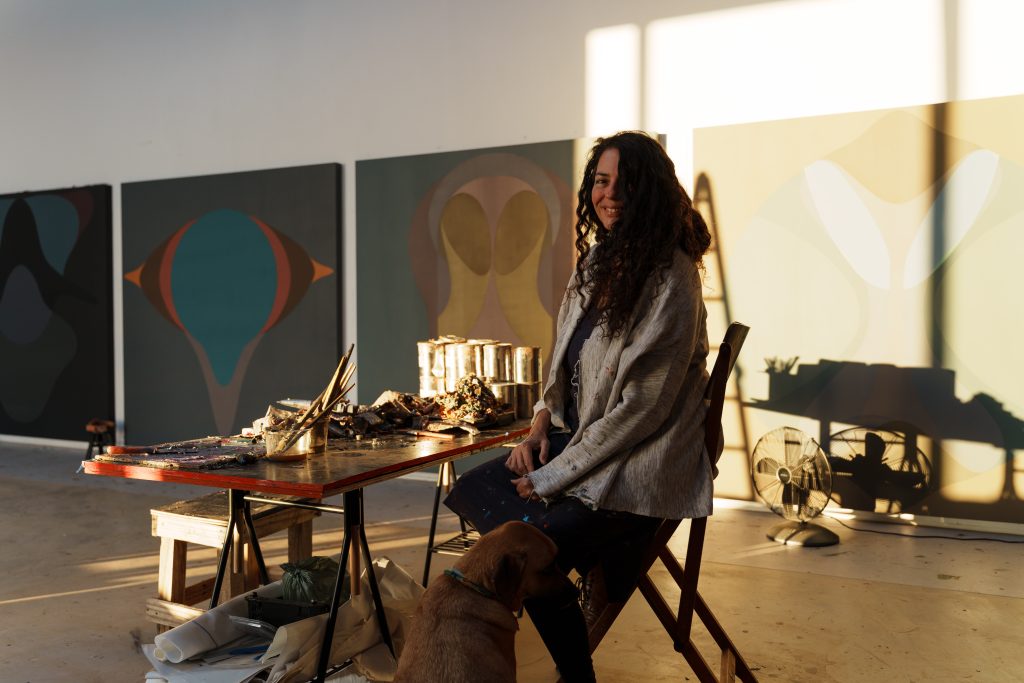
The exhibition unfolds two lines of investigation that have converged in Camargo's research over the past few years: the materiality of color and the intangible forces that connect celestial bodies to terrestrial life. The artist approaches the Serra do Cipó as a system of forces and conditions that make perception possible. "Her interest has gradually shifted from representation to the investigation of the very conditions under which seeing, feeling, and knowing become possible," writes López.
At either end of the gallery, two large-scale polyptychs occupy opposing positions: Full Moon and New Moon. Each translates, through delicate tonal gradations and modulated chromatic sequences, the variations in light associated with two opposite moments of the lunar cycle. The New Moon, when the moon is positioned between the Earth and the Sun, becoming practically invisible, is dominated by darkness. The Full Moon, when the Earth is between the Sun and the Moon, responds with intense luminosity. The polyptychs are constructed as grids of circles suspended on flat backgrounds, and their monumental scale introduces a dimension that alludes to the magnitude of the forces associated with the moon and its role in structuring the rhythms of the living world.
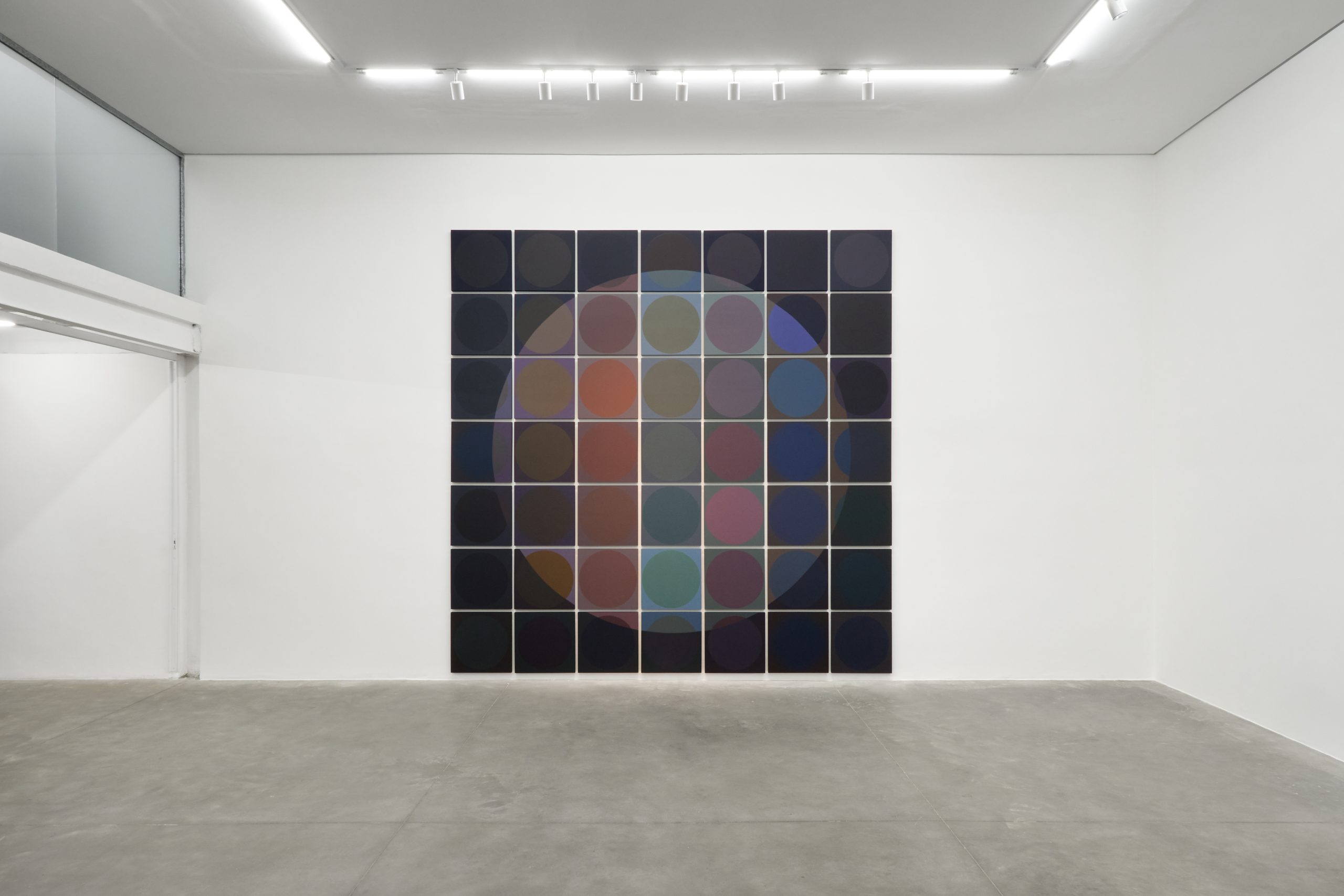
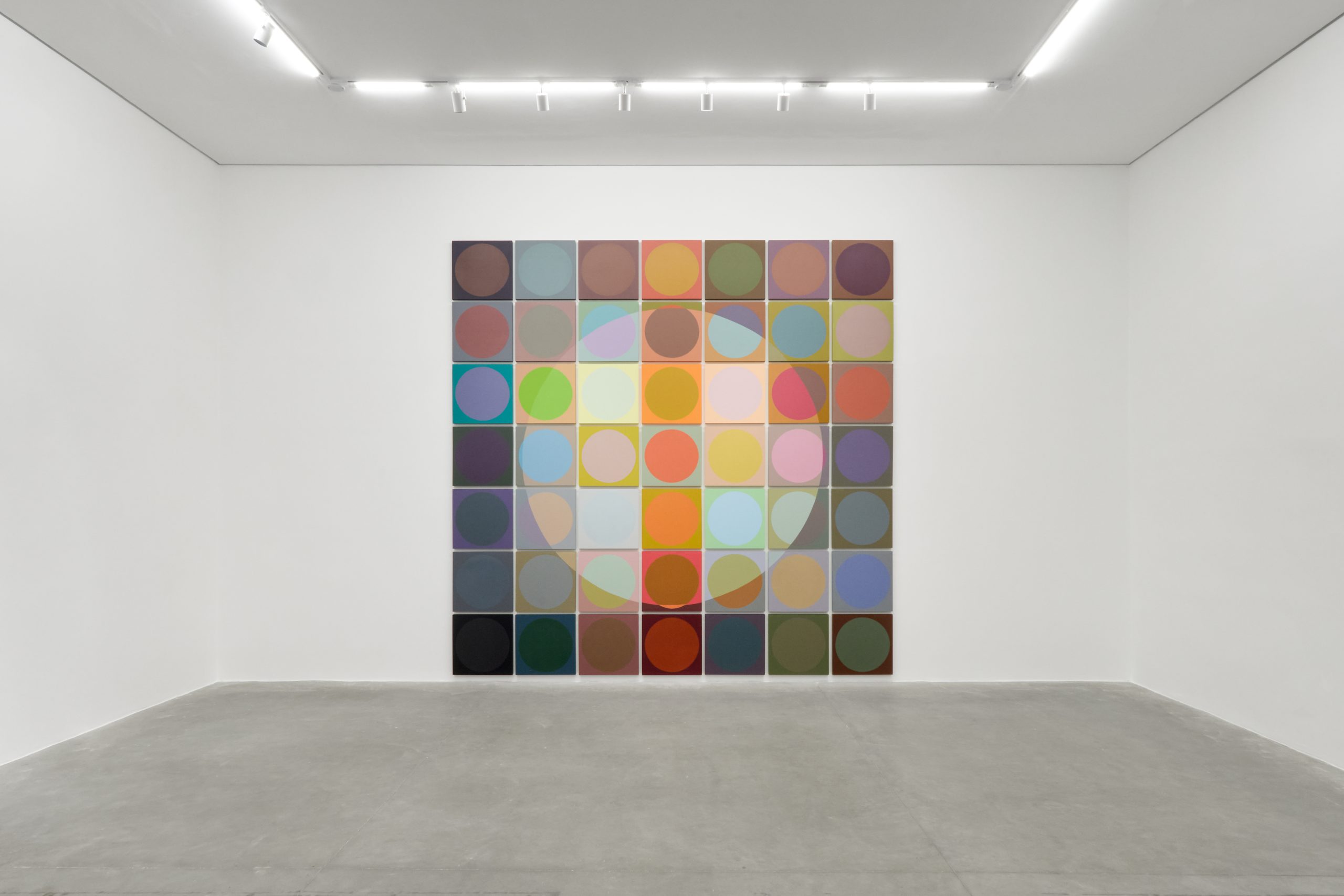
The choice of the moon is due to the fact that it represents the celestial body that accompanied Camargo in his daily experience in Serra do Cipó, becoming part of his experience in that territory. For López, the artist positions herself in a space where, “More than just observing a landscape, she dedicates herself to a dense network of relationships and interdependencies.".
On the gallery's largest wall, positioned between the two polyptychs, four medium-sized paintings present sinuous and undulating forms emerging against darkened backgrounds. López describes them as "being-forms": silhouettes that could be plants, water currents, seeds, animal shadows, magnetic fields, or atmospheric phenomena. Camargo's interest lies outside this classification; she is drawn to the presence of forces that escape linguistic determination.
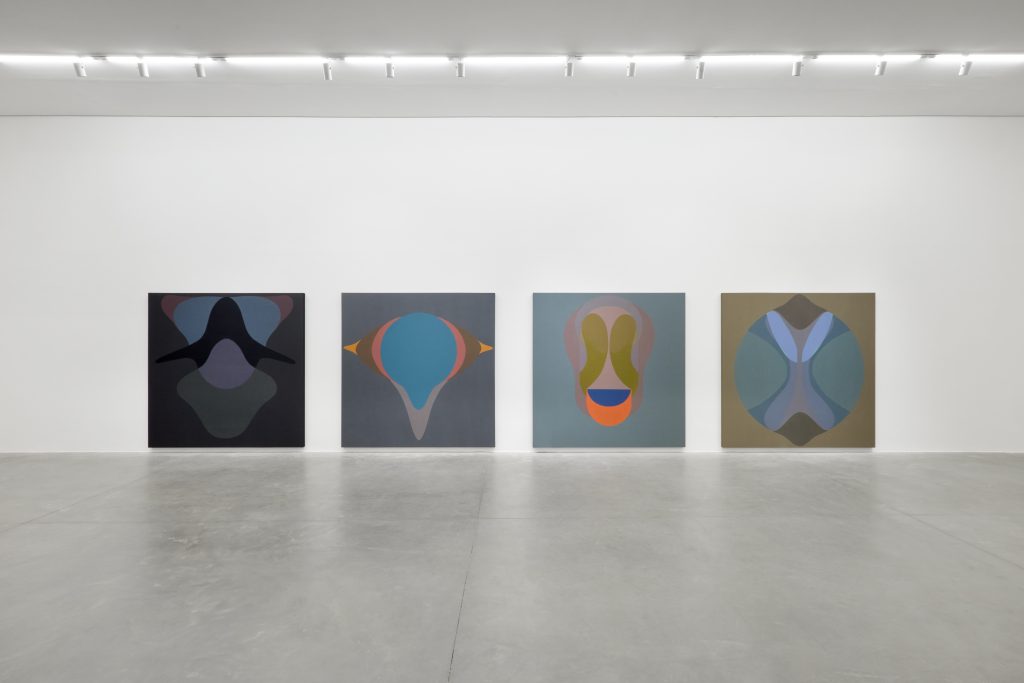
According to the curator, color in Camargo's painting "goes from being a stable attribute to becoming an event: an unstable vibration that oscillates between sensory experience, scientific observation, and poetic speculation. It is precisely in this instability that Camargo situates his practice."
From Erosion to Candlelight: From the Geological to the Astral
The exhibition extends and reconfigures a visual vocabulary that Camargo has been building throughout his career. His work is structured in series that investigate both the geometric repertoire of the city—defined planes, rigid lines, brutalist structures—and the instability of nature, especially from his immersion in the Minas Gerais savanna.
In “Erosions” (2019), at Central Galeria, the artist directed her attention to the geological processes that shape the Earth's surface: rocks, sediments, and the traces left by rain, wind, and erosion appeared as material inscriptions of time. In “candeia,” the movement is one of expansion. From the geological to the astral, from eroded matter to gravitational and luminous forces, from soil layers to cyclical configurations that exceed human temporality. “Camargo doesn't just paint what we see, but the conditions that make seeing possible,” concludes López.
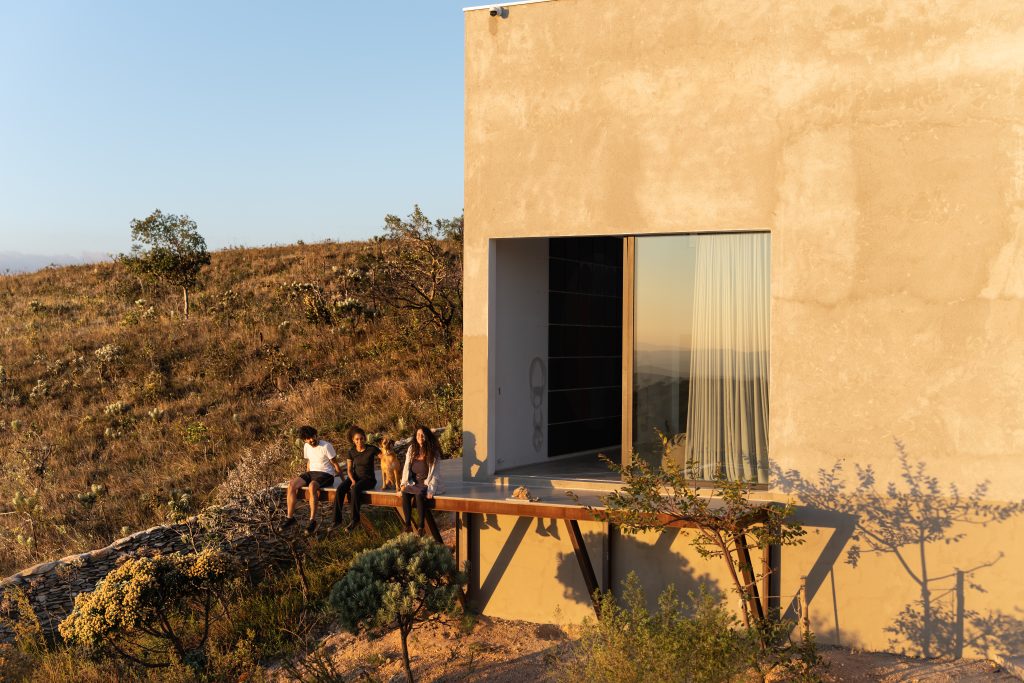
A studio that is also a residence and, in the future, an institute.
The studio in Serra do Cipó goes beyond the individual space of creation. The project envisions a multidisciplinary residency designed to host artists, biologists, botanists, firefighters from the Cerrado biome, astronomers, and researchers from different fields in a real immersion in the territory. “What I want is for this to generate an exchange of knowledge, expertise, and interests,” explains Camargo. In the long term, the artist plans to establish an institute dedicated to the study of the region's environment, a space that, in her words, “can eternally receive these people and give something back to the place itself.”
“I believe that contemporary artists have a role to play in society and in humanity,” he states. “It’s part of my own work to be able to do something physical in that sense: to bring other people to experience this place that I love so much.”
Mitre Gallery
Mitre Galeria was founded in 2023 by Rodrigo Mitre in Belo Horizonte, and opened its São Paulo headquarters on Rua da Consolação in 2025. In a short time, it has accumulated accolades: it received the Focus Stand Prize at Frieze New York in 2025, with a solo project by Luana Vitra — who also stood out at the 35th São Paulo Biennial — and had works by its artists acquired by the Dallas Museum of Art (Wallace Pato, 2025) and the Phillips Collection in Washington (Diego Mouro, 2026). The gallery represents artists of different generations and backgrounds, including Luana Vitra, Davi de Jesus do Nascimento, Marcos Siqueira, and Gisele Camargo herself, and participates in fairs such as Frieze New York, EXPO Chicago, and SP-Arte.
SERVICE
candle — Gisele Camargo
Curatorial text: Miguel A. López
Mitre Gallery São Paulo — Rua da Consolação, 2761, Jardins, São Paulo
On view until October 3, 2026
Tuesday to Friday, 10am–19pm | Saturday, 11am–17pm
Free entry